
Lincoln County's Active Warrant List Was Not Located
Lincoln County publishes no active-warrant search anywhere. The county home page, the sheriff's pages, the district court page, all five city sites, and the news index carry no outstanding-warrant spreadsheet and no downloadable roster. The sheriff's menu has no warrants item at all. Nothing hides behind a tab. That absence is real, not a guess. An agency may still keep a warrant index internally, share it with law enforcement alone, or release a record after a classification review. So a missing list proves nothing either way. The working route in Lincoln County runs through the courthouse and the sheriff's office.
Active Warrants in Lincoln County
Active means live. A warrant stays active until a judge ends it or an officer serves it. Minnesota judges issue warrants in district court after a complaint and a probable cause showing. Service can happen anywhere in Minnesota. The one limit is where the law forbids it. Active status is not an open charge. It is not a missed payment. It is not a license hold either. Each of those can sit beside a warrant without being one. Only the court that signed the warrant settles the status, and the sheriff holds the service record in Lincoln County. Note: An old warrant does not expire, and it never leaves a case file just because no public page lists it.
How the Lincoln County Active Warrant List Works
Lincoln County answers warrants by phone and at the counter. The sheriff's administration page lays out the department's duties with no warrant publication program on it.
That same page lists the law-enforcement work around a warrant: investigations, civil process, court orders, the jail, and the communications center. Two offices split the answer. Court Administration reads the register. Staff confirm whether a warrant exists and whether it is still active. The sheriff confirms service and custody. Minnesota's public case search shows the case, and a warrant entry may appear in the Register of Actions, but the interface never promises a live active-warrant field.
Why No Lincoln County Warrant List Proves Nothing
A blank search settles nothing. People treat missing results as clearance, and that habit causes real trouble. Minnesota classifies arrest-warrant-index data as confidential until the defendant is taken into custody, served with a warrant, or appears before the court, unless the agency decides release serves a public purpose. A newly issued warrant can stay out of view. So can a sealed case. An active investigation too. Freshness matters as well. A court posts its weekly calendar by 7 a.m. each business day and updates it hourly, yet the calendar leaves out confidential cases and changes without notice. Lincoln County searchers should remember that a published schedule and a warrant index are different products.
What an Active Warrant Shows
Lincoln County has no public warrant screen to inspect. The fields that follow map what a court file or law-enforcement record can carry, so ask for them by name when you call.
| Warrant type | Arrest, bench, failure to appear, sign-and-release, or release condition |
|---|---|
| Case number | Court file identifier, shown in the pattern NN-CR-YY-NNNN |
| Charge and statute | The offense the warrant was issued on |
| Issuing judge and court | The district court that signed the warrant |
| Issue date | The date the warrant was signed and entered |
| Bail and conditions | Amount and conditions set on the warrant |
| Status | Active, served, recalled, or quashed |
| Service record | Date and method of service where that data are public |
| Recall order | The court order that changed the status |
| Classification flag | Sealed, juvenile, or active-investigation treatment |
Lincoln County Warrant Index Confidentiality
Minn. Stat. § 13.82, subd. 19 sits behind most refusals. It makes arrest-warrant-index data confidential until the defendant is in custody, served with a warrant, or appears before the court, unless the agency makes a public-purpose determination. Subdivision 7 protects active investigative data on its own. A warrant index is not an arrest record. Once an arrest happens, the arrest data become public. They carry time, place, agencies, custody location, transfer, release, and an incident number. That index can stay closed. Under the Minnesota Government Data Practices Act, a denial has to identify the specific classification authority the office relied on. Ask for that citation in writing. Lincoln County offices answer under the same statute.
Most-Wanted Lists and Warrant Roundups
Lincoln County posts no most-wanted roster. There is no reward schedule and no warrant roundup docket either. The sheriff's page does link a tip channel for a regional drug and violent crime task force, which takes safety information from the public. That channel is not a warrant list. The county does not use it to confirm warrant status. No office here runs a warrant-amnesty day, and the county news index, board material, and state court pages carry none. Look-alike programs do not substitute. A court payment plan is a financial arrangement. A task force is an enforcement partnership. Neither recalls a warrant or waives a fee, and any future public-safety list should be read at the official source in Lincoln County rather than a repost.
| Comparison Point | A Published Most-Wanted List | An Active Warrant |
|---|---|---|
| Who chooses it | The agency, for public-safety attention | The judge who signs the warrant |
| What it covers | A curated subset of open matters | One warrant in one case file |
| What it proves | That the agency wants help finding someone | That a judge issued process that remains uncleared |
| What to do with it | Read the official page, and never republish the roster | Confirm status with the court and the sheriff |
Key Point: An official list would describe a program, not a case status. Only the court that issued a warrant can confirm whether that warrant is still active.
When a Lincoln County warrant turns out to be active, the full county overview covers the resolution steps.
Lincoln County Warrant Check Routes
Two Ivanhoe buildings hold what a Lincoln County warrant check needs, a block apart. The courthouse on North Rebecca Street houses the district court file and the Court Administration counter, open Monday through Friday, 8:30 a.m. to 4:30 p.m. Behind it, on North Wallace Street, sits the Law Enforcement Center. That building holds the jail with room for 15 inmates and a 24-hour communications center. The sheriff's office page lays out the building and what the office does.
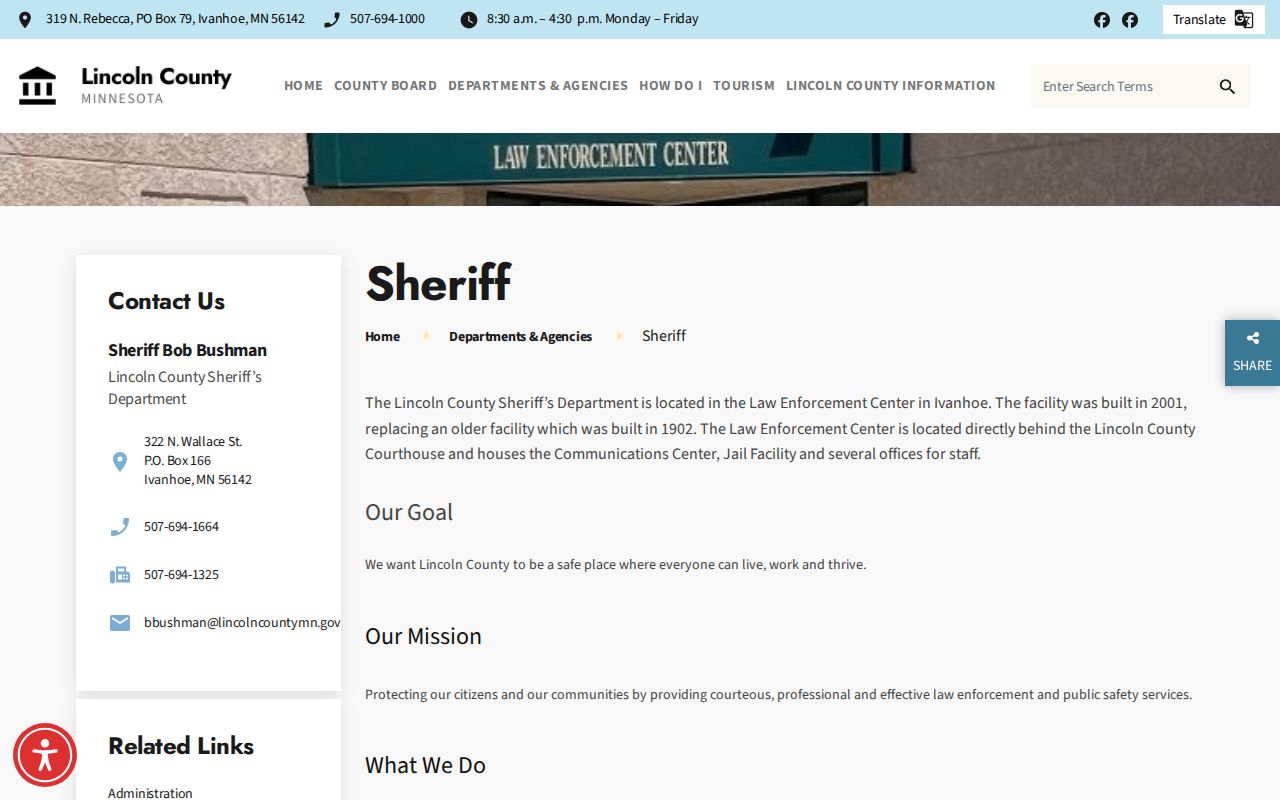
The office lists a main phone number and a fax line. Lincoln County offers no walk-in warrant counter or bond window there, so call ahead before driving over.
If Your Name Is on the List
Write down what you actually have before anything else: the case number, the charge, the court date, and the office that told you a warrant exists. Ignore screenshots, social-media posts, and unsolicited calls. Anyone demanding card details over the phone and threatening instant arrest is not a court. Next, call Court Administration at 507-680-7005, or 507-694-1355 for traffic questions, and ask whether an active warrant still shows in the court system. An attorney can sort out the real options, which usually mean a court appearance, a planned surrender, bail, or a motion to recall or quash. The home page section on what to do about a Lincoln County warrant walks through those same steps in order.
A License Hold Is Not Warrant Status
Traffic cases bring a second status that people confuse with an active warrant. When you miss a court date, the court can report the failure to appear to the state, and the Department of Public Safety can suspend a driver's license under Minn. Stat. § 169.92 and Minn. Stat. § 171.16. Those statutes cover reporting and licensing consequences, not a warrant lookup. A suspension after a missed Lincoln County court date is its own administrative status. Fixing it does not clear an outstanding warrant, and clearing the warrant does not restore a license on its own. Ask the court about the case and the driver's compliance office about the license; the driver compliance page covers the licensing side.